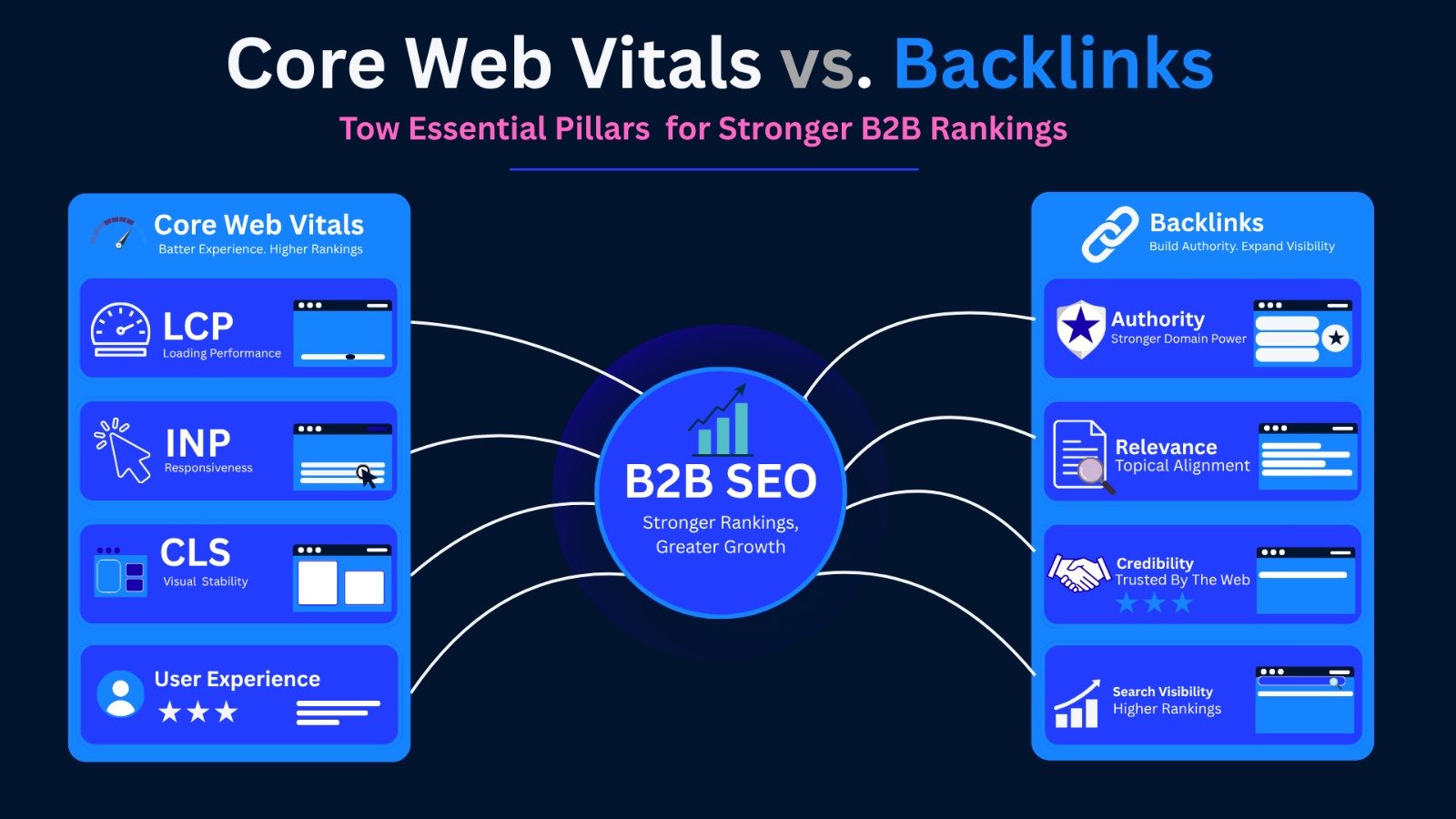

Higher rankings in B2B SEO help businesses gain visibility, qualified traffic, and leads. However, strong rankings require more than quality content and keywords. Core Web Vitals focus on website speed, responsiveness, and user experience, while backlinks build authority and credibility. Together, they create a stronger SEO foundation. In this guide, we’ll explore how Core Web Vitals and backlinks impact B2B rankings and how businesses can improve both.
What Are Core Web Vitals?
Core Web Vitals are a set of Google’s metrics that measure important aspects of a website’s user experience and performance. They focus on three key areas: loading performance, responsiveness, and visual stability.
LCP (Largest Contentful Paint) measures how quickly the largest visible content element of a page becomes available. A faster LCP means visitors can start viewing important content sooner.
INP (Interaction to Next Paint) measures how quickly a website responds when a user interacts with it, such as clicking a button, opening a menu, or filling out a form. A good INP makes the site feel responsive and smooth.
CLS (Cumulative Layout Shift) measures how much page content unexpectedly moves while loading. A low CLS helps prevent frustrating situations, such as clicking the wrong button because the page suddenly shifts.
Together, these metrics help businesses create a faster, smoother, and more user-friendly website.
Why Core Web Vitals Matter for B2B Websites
Core Web Vitals matter for B2B websites because website performance directly affects user experience and engagement. When a website takes too long to load, responds slowly, or shifts unexpectedly, visitors may become frustrated and leave before exploring the business or its services. This is especially important for B2B companies, where potential customers often visit a website to research solutions, compare providers, or request more information.
A fast and responsive website makes it easier for visitors to find what they need and interact with important elements such as contact forms, product pages, and calls to action. Improving LCP, INP, and CLS can create a smoother browsing experience and help reduce user frustration. Better performance can also support SEO efforts by ensuring the website provides a strong overall user experience, helping businesses attract and retain more potential customers
How Backlinks Affect B2B SEO
Backlinks are links from other websites to your website. In B2B SEO, they can help improve a website’s authority, credibility, and search visibility. When a trusted and relevant website links to your content, it can provide a signal of relevance and authority.
However, quality matters more than quantity. A backlink from a reputable website within your industry is generally more valuable than many links from unrelated or low-quality sites. Relevance also matters because links from websites related to your niche provide stronger context.
For B2B businesses, focusing on relevant, trustworthy, and high-quality backlinks is a better strategy than simply trying to build as many links as possible.
Core Web Vitals vs. Backlinks
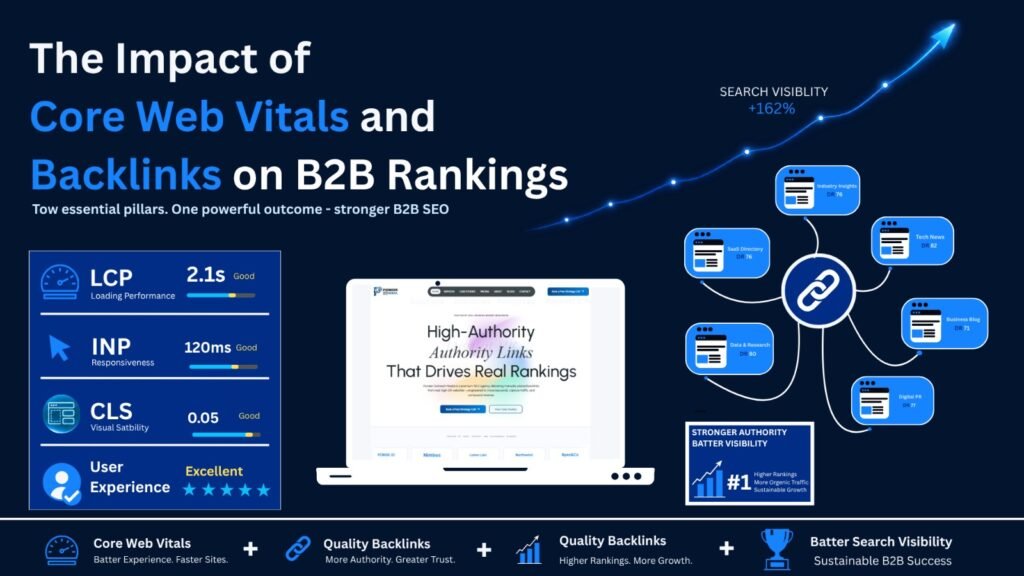
Core Web Vitals and backlinks both support B2B SEO, but they play different roles. Core Web Vitals focus on the user experience and technical performance of a website. They measure factors such as loading speed, responsiveness, and visual stability. A website with good performance provides visitors with a smoother experience and makes it easier for them to browse and interact with the content.
Backlinks, on the other hand, focus more on authority and credibility. When relevant and trustworthy websites link to your content, they can help strengthen your website’s authority and search visibility.
In simple terms, Core Web Vitals help create a better website experience, while backlinks help build website authority. Neither should be ignored in a B2B SEO strategy. A fast, user-friendly website supported by relevant, high-quality backlinks creates a stronger foundation for long-term search performance and can help businesses attract more relevant visitors.
How to Build a Strong B2B SEO Strategy
A strong B2B SEO strategy requires more than focusing on a single ranking factor. Businesses should combine quality content, technical SEO, Core Web Vitals, and relevant backlinks to build a strong and sustainable search presence.
Start with quality content that answers your target audience’s questions and provides useful, original information. Well-researched content can attract visitors and create opportunities to earn natural backlinksNext, focus on technical SEO. Make sure your website is easy for search engines to crawl and index, has a clear site structure, uses proper internal linking, and works well on mobile devices.
Core Web Vitals should also be part of your technical strategy. Improve loading speed, responsiveness, and visual stability to provide visitors with a smooth browsing experience.
Finally, build relevant, high-quality backlinks from trustworthy websites within your industry. Prioritize quality and relevance rather than simply increasing the number of links.
By combining these four elements, B2B businesses can build a stronger SEO foundation, improve search visibility, attract qualified traffic, and support long-term growth
Practical Tips
Improving B2B SEO does not always require major changes. Start by optimizing images through compression and modern formats to improve loading performance. Remove unnecessary scripts, plugins, and third-party tools that may slow down your website. Reliable hosting and caching can also help improve overall performance.
For backlinks, focus on relevant and trustworthy websites within your industry. Guest posting, digital PR, industry partnerships, and useful resources can help businesses build quality backlinks. Avoid low-quality or unrelated links simply to increase backlink numbers.
Regularly monitor Core Web Vitals, broken links, mobile performance, and technical SEO issues to identify problems early. Consistent improvements can create a faster, more user-friendly website while supporting stronger B2B SEO performance over time.
Conclusion
Core Web Vitals and backlinks play different but important roles in a successful B2B SEO strategy. Core Web Vitals help create a faster, smoother, and more user-friendly website, while relevant backlinks can strengthen authority and credibility. However, businesses should not focus on either factor alone. Combining quality content, technical SEO, strong website performance, and high-quality backlinks creates a more complete SEO foundation.
The key takeaway is simple: build a website that provides a strong user experience, create content worth referencing, and earn relevant backlinks consistently to support long-term B2B search visibility and growth.